
In 1889 the military forts at Middle Head held large 6-inch guns on ‘disappearing’ carriages which recoiled into a pit to be reloaded. Watch this animation to see how the guns were designed to protect Sydney Harbour.
1870s - protecting the harbour
Outer Fort design
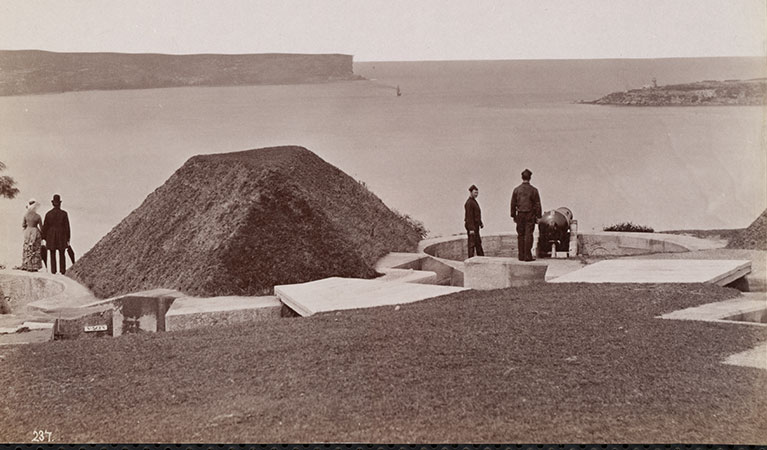
The original 1870s design of the Outer Fort had 7 circular gun emplacements arranged in a slight arc, providing clear views to the harbour entrance.
These were connected by narrow passages and 'magazines', which are areas to store the shells or ammunition.
 }
}
Positioning the guns
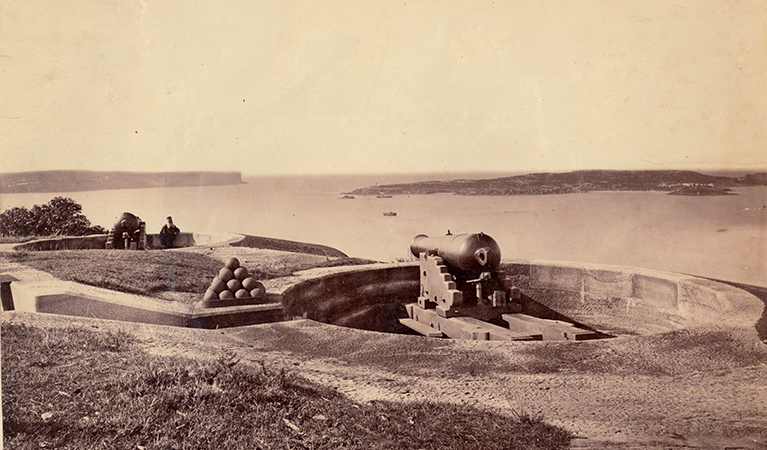
The gun emplacements were dug by hand into the hard sandstone. It was hard work moving the guns into place using ropes and pullies.
Up to 20 men were needed to load the guns into position. All materials were transported to the headland by horse and cart.
 }
}
In defence of Sydney
Outer Middle Head changed as technology improved. 1877 saw the arrival of British military advisers Governor Sir William F.D. Jervois and Lieutenant-Colonel Peter Scratchley. Their job was to assist Australia and New Zealand to coordinate their defences on behalf of the British Empire.
The small muzzle loading guns were removed and replaced with very large guns – 10 inch, 18 ton rifled muzzle loaders. Electricity was connected to the fort and communications were improved.
From 1885 the Middle Head area became part of the School of Artillery where people trained to use the guns and transport them.
During the First World War (WW1) older installations were decommissioned and replaced with newer guns. In the 1940s, with the onset of the Second World War (WW2) and fears of invasion, construction went full steam ahead, often without adequate planning or materials.
New guns and technology were installed. The Central Control building was extended, radar was installed, and the fort was manned 24/7 to watch for foreign objects entering the headlands.
There were many dangers for the men who operated the guns – even during training and injuries were not uncommon. The sound and vibration of the guns exploding when fired could lead to loss of consciousness and loss of hearing known as 'gunners' ear.
'Sometimes you can't see too much in the dark and when you fire a guns at night... you should close your eyes a fraction before they pull the trigger... because when the gun explodes, there's a blinding light and if you've got your eyes open you'll lose your night vision. And after you can't see a damn thing.'
John Johnston, who served during the war with the artillery, c.1942
The tiger cages
After WW2 the military had limited use for these fortifications. However, specialist training was carried out during the 1950s and 1960s in the subterranean tunnels and rooms.
The former engine room became known as the 'tiger cages'. Men in training were 'abducted' and spent several days undergoing conditions they could have faced if captured during active overseas duty.
'We were taken to what must have been the oldest part, where the water dripped incessantly and the walls were discoursed by age and slime…there was…. a series of cells through which we were rotated like restless itinerants at any time, day or night. Each had its singularly offensive characteristic. There was one I dubbed the “Music Room”, where a loudspeaker in the ceiling blared…..the “Whistleshop” had another loudspeaker….it emitted a series of high shrieks so penetrating that it was virtually impossible to sleep or think clearly.'
Barry Peterson, an early participant who experienced the Tiger Cages.
Originally dug by hand in the 1870s, Middle Head's Outer Fort evolved several times over 100 years as technology changed and the guns needed to evolve. Watch the animation to see the guns in action.
Visit
-
Middle Head – Gubbuh Gubbuh
Middle Head – Gubbuh Gubbuh ('gub-uh, gub-uh) is one of Sydney Harbour's 7 headlands. Enjoy scenic views of Sydney Harbour from the lookout or explore the historic fort and military relics.